


General information only, not legal advice.
A valid will lets you, not the law, decide who inherits your estate in England and Wales. It also names the people who carry out your wishes, and it can save your family cost, delay and argument. This guide explains why a will matters, what makes one legally valid, how inheritance tax fits in, and how to keep a will safe and up to date.
Why a will is important
A will is the only reliable way to decide who receives your property, who cares for your children and who handles your affairs after you die. Without one, you die intestate and the rules of the Administration of Estates Act 1925 decide for you.
- You choose who inherits. Intestacy passes your estate to relatives in a fixed order, regardless of your wishes.
- Unmarried partners are not protected. A cohabiting partner has no automatic right to inherit, no matter how long you have lived together. Only married or civil partners and certain relatives inherit under the rules.
- A spouse may not get everything. If you leave a spouse or civil partner and children, the spouse takes your personal belongings, the first £322,000 and half of the rest. The children share the other half.
- You choose your executors, the people who gather your assets, pay debts and tax, and distribute the estate, instead of leaving the court to appoint administrators.
- You can name guardians for children under 18.
- You can plan for tax and use trusts, for example to protect assets for children or for a second spouse.
- You reduce the risk of dispute and delay. A clear, properly signed will leaves less to argue about.
A will does not stop every challenge. Under the Inheritance (Provision for Family and Dependants) Act 1975, certain people, including a spouse, children and a cohabitant, can ask a court for reasonable financial provision from the estate, with or without a will. The diagram below shows the order the law follows when there is no will.
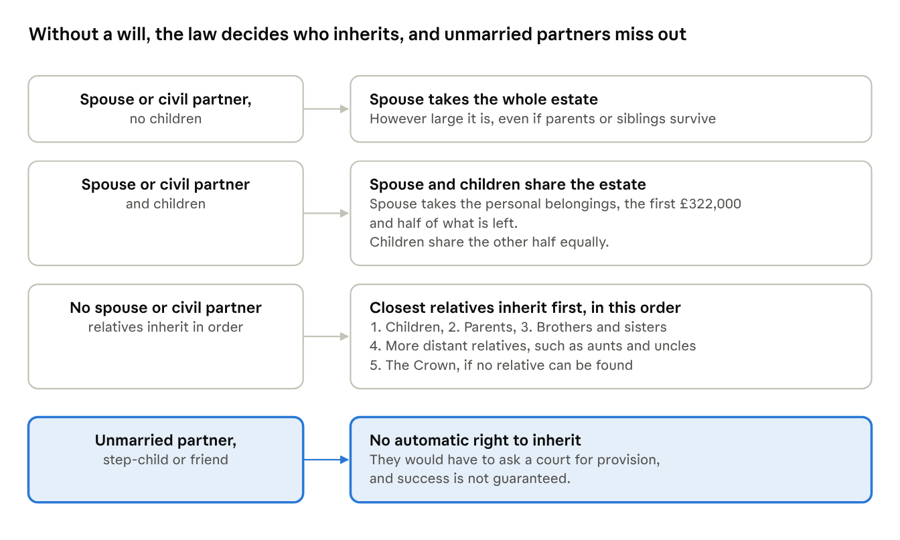
who inherits without a will · 4 situations
The first £322,000 is a fixed legal sum, so in a smaller estate with children the spouse can take everything.
What makes a will valid: the formalities
The formal rules are in section 9 of the Wills Act 1837. If a step is missed, the will can be invalid even where your wishes are perfectly clear, so the signing matters as much as the wording.
The five formal steps
- In writing. The will can be typed or handwritten.
- Signed by you, or by someone else in your presence and at your direction.
- Intended as your will. You must mean the document to take effect on your death.
- Witnessed by two people. You sign, or acknowledge your signature, in front of two witnesses who are both present at the same time.
- Signed by each witness in your presence.
Capacity and free choice
- You must be 18 or over.
- You must have mental capacity. Courts apply a long-standing common-law test (Banks v Goodfellow, 1870): you understand what a will is and what it does, roughly what you own, and who might reasonably expect to benefit.
- You must know and approve the contents, and make the will freely, without undue influence or pressure.
- If capacity might later be questioned, because of age or illness, ask the solicitor to record an assessment at the time of signing.
Choosing witnesses
Use two adults who are independent and who watch you sign. A witness, or a witness’s spouse or civil partner, should not be a beneficiary. The will stays valid, but that person’s gift is generally lost.
Marriage, divorce and later changes
- Marriage or civil partnership revokes an existing will, unless the will was made in contemplation of that marriage. Make a new will after marrying.
- After divorce or dissolution the will remains valid, but gifts to your former spouse, and their appointment as executor, generally fail as if they had died before you.
- A change to a signed will can be made by a codicil, which must be signed and witnessed with the same formalities. For anything substantial, a new will that revokes the old one is safer.
Electronic wills are not yet valid
A will made in England and Wales today must still be a physical document signed and witnessed in person. The Law Commission recommended in May 2025 that electronic wills be recognised, with a draft Wills Bill, but at the time of writing no Bill had been introduced. Check for later developments before relying on a digital process.
The diagram below shows the signing sequence and the witness trap that catches many home-made wills.
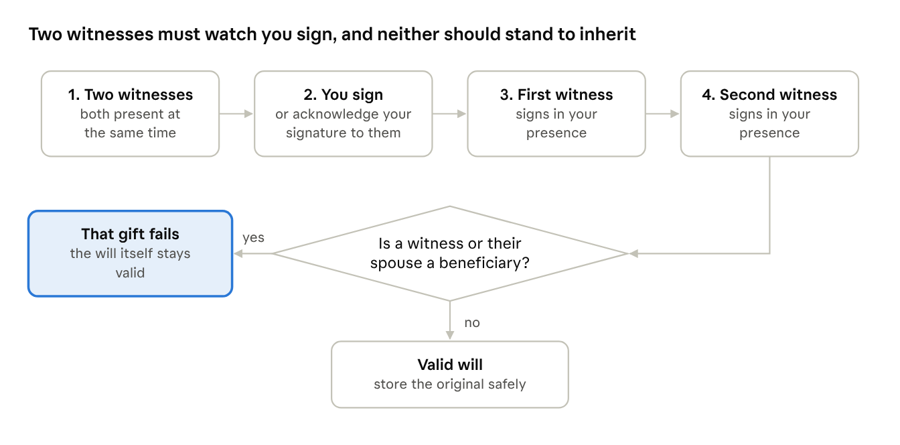
signing sequence and witness check · 4 steps, 1 decision
An independent witness keeps the whole will safe: only a gift to a witness or their spouse is lost.
Inheritance tax and your will
Inheritance tax (IHT) is charged at 40% on the part of an estate that exceeds the available tax-free allowances. A will cannot remove the tax, but it decides who receives what, and that affects how much of the allowances are used.
| Allowance | Amount | What to know |
| Nil-rate band | £325,000 per person | Frozen until 5 April 2031. |
| Residence nil-rate band | Up to £175,000 per person | Only where the home passes to children, grandchildren or other direct descendants. Reduced by £1 for every £2 the estate exceeds £2 million. Frozen until 5 April 2031. |
| One person, both bands | Up to £500,000 | The two bands added together. |
| Married couple or civil partners | Up to £1 million | Unused allowance can pass to the surviving spouse or civil partner. |
| Rate | 40% above the allowances | 36% if at least 10% of the net estate goes to charity. Gifts between spouses or civil partners are generally exempt. |
IHT is normally due within six months of the end of the month of death. These figures change with each Budget, so check the current rules on GOV.UK or with an adviser before relying on them.
How to keep your will safe and effective
Only the original signed will is legally valid. If your executors cannot find it, the estate can face delay, extra cost and stress, so drafting, storage and upkeep all matter.
Get it drafted properly
- Use a solicitor or a regulated will writer, especially if you own property, have a blended family, run a business or want to use trusts.
- Have the signing supervised so the formalities are followed exactly.
- Name backup executors and backup beneficiaries in case someone dies before you or cannot act.
- Describe gifts clearly, and say what happens to the rest of the estate (the residue).
Store the original
| Where | What to know |
| With the solicitor who drafted it | Usually free. A solicitor who did not draft it may charge a fee. Ask about insurance for lost or damaged wills. |
| With a will-writing service | Often included, or for a one-off or annual charge. Check what happens if the company stops trading. |
| With the Probate Service (HMCTS) | The government stores it for £23 in England and Wales. Your executors collect it after your death. |
| At home | Free, but the will can be lost, damaged or thrown away. Use a fireproof safe or secure cabinet and tell your executors where it is. |
| In a bank safety deposit box | Avoid. The bank cannot open it until the executor has a grant of probate, and the executor needs the will to apply for one. |
Whichever you choose, write down where the will is, including any reference numbers, and give that note to your executor. You can also record its location on the National Will Register for a small one-off fee, which helps if you move house or your solicitor retires or closes.
Protect the document
- Never attach anything to the signed will with staples, paperclips or pins. It can raise doubts about whether pages were removed or replaced.
- Do not write on it or cross anything out after signing. Make changes with a codicil or a new will.
- Keep a copy for reference but remember that only the original is valid.
Keep it up to date
Review your will every couple of years and after any of these events:
- Marriage or civil partnership (which cancels an earlier will) or divorce
- Separation, if you are unmarried
- Children or grandchildren
- Buying or selling a property, or a significant change in your finances
- The death of an executor or beneficiary, or a change in your relationship with one
For a minor change, such as a new executor or address, a codicil can be enough. For a major change, make a new will and dispose of the old one properly.
Remember what a will does not cover
- Jointly owned property often passes automatically to the surviving owner, outside the will.
- Pensions and life insurance usually pay out under their own nomination or trust arrangements, so keep those up to date too.
- A will only operates on death. Lasting powers of attorney cover decisions about your health, welfare or finances if you lose capacity while alive.
- A non-binding letter of wishes can guide executors on personal items and funeral preferences.
Common mistakes to avoid
- Witnesses who are not together. Both witnesses must be present at the same time when you sign or acknowledge your signature.
- A beneficiary as witness. The will survives, but that person’s gift is generally lost.
- Forgetting that marriage cancels a will. A will made before marrying or entering a civil partnership is usually revoked unless it was made in contemplation of that marriage.
- Marking the signed will. Staples, notes and crossings-out can raise questions about what was in the document when you signed it.
- Never reviewing it. Executors, beneficiaries, property and family circumstances change.
- Losing the original. Only the signed original is valid, and a missing original can lead to extra legal steps to prove the will.
- Assuming the will controls everything. Jointly owned property, pensions and life insurance often pass outside it.
- No backups. If a named executor or beneficiary dies or cannot act, a backup avoids gaps and court applications.
Frequently asked questions
Do I need a solicitor to make a will? The law does not require one, and a handwritten will is valid if it meets the formalities. Mistakes are easy to make, though, so professional help is sensible if you own property, have children from more than one relationship, run a business or want to use trusts.
Can I make a will online? Online services can help you prepare the wording, but the will must still be printed, signed and witnessed in person. Typing a name or signing on a screen does not currently satisfy the law.
What happens if I die without a will and have no relatives? Where no relative can be found, the estate passes to the Crown.
Can a will be challenged? Yes. Common grounds are lack of capacity, lack of knowledge and approval, undue influence and failure to follow the formalities. Separately, certain family members and dependents can apply to court for reasonable provision under the Inheritance (Provision for Family and Dependents) Act 1975.
Is a will private? Once probate has been granted, a will normally becomes a public document that anyone can request a copy of. Keep private wishes in a separate letter of wishes rather than in the will itself.